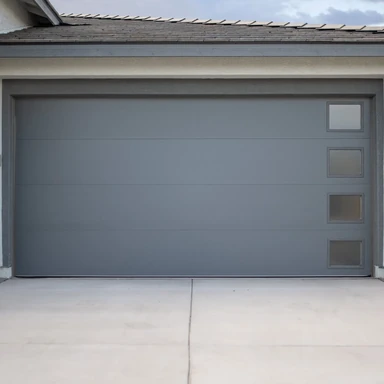
A commercial door is judged on cycles per day, not on how it looks from the street.
We are a matching service, not the contractor. Commercial and oversized door work goes to licensed garage door companies serving Fairfax County, and you hold the contract and the warranty with the firm you hire. The buildings here that need this work are service bays, contractor shops, storage and flex units, church halls, restaurant loading doors and fire station apparatus bays.
A commercial sectional door is the same idea as a residential door, built heavier: two inch panels, 20 or 24 gauge steel faces, four inch horizontal struts on doors wider than about ten feet, and a track that is specified rather than assumed. Overhead Door lists standard maximum heights at 24 feet 1 inch and maximum widths from 14 feet 2 inches to 22 feet 2 inches across its commercial lines, with the widths set by model.
A rolling steel door coils into a compact barrel above the opening instead of running back along ceiling tracks, which is the answer where the ceiling is low or the space behind the door is in use. A sectional door insulates better and can be glazed. Overhead Door publishes an R-value of 7.6 for one insulated commercial series. A residential door from Clopay runs from 6.3 to 20.4, and that difference is about keeping a hallway warm rather than a workshop. Commercial insulation is about controlling the building, not about comfort in a hallway.
Oversized is a relative word. A 16 foot door on a contractor shop is ordinary. A 24 foot door on an apparatus bay is a different engineering problem, because the panels have to carry their own weight across the span without sagging, and that is what the struts and the heavier gauge are for.
Four track layouts cover most buildings. Standard lift runs the door back horizontally close to the ceiling. High lift runs it up vertically before it turns, which is what a tall ceiling or a crane rail requires. Vertical lift runs the door straight up and keeps all of the ceiling clear. Low headroom folds the door back quickly for a shallow space under a mezzanine or a duct.
The layout is chosen from measurements: headroom above the opening, sideroom beside it, depth behind it, and whatever is already hanging from the ceiling. A building that has gained a heating unit and a fire sprinkler main since the door was installed may no longer have the headroom its original track assumed, which turns a door replacement into a track redesign.
Overhead Door rates its commercial sectional springs at 10,000 cycles as standard, with high cycle springs offered at 25,000, 50,000 and 100,000 cycles. A residential door at four cycles a day takes years to reach 10,000. A service bay that opens thirty times a day reaches 10,000 in under a year, which makes the standard spring a maintenance item rather than a lifetime part.
That is the whole commercial spring conversation. On a busy bay, price a high cycle spring first and treat the standard one as the short lived option. On a storage unit opened twice a day, the standard rating is generous.
Gravity is the other half of the argument. A large door is heavy enough that a miscalculated spring does not run slow, it drops.
Commercial doors carry devices a residential door does not: safety edges on the closing edge, photo eyes at the opening, broken cable devices that stop a door when a cable fails, and often a chain hoist for manual operation in a power cut. Each of those is a part that has to be tested, not just present.
Service is scheduled rather than called for. An annual visit that checks spring tension, cable condition, roller wear, hinge bolts, track alignment and every safety device is cheaper than the call that follows a failed cable on a Friday morning with a delivery waiting.
Fairfax County Land Development Services at 703-222-0801 is the right call for anything beyond a like for like replacement, since enlarging an opening or altering the structure around it is permit work. Salt and plow damage on the apron in front of the door is the local wear item; a bottom section that has been hit by a plow blade is a panel and a seal, not a new door.
Usually, yes. Springs, cables, rollers, hinges, track sections, bottom sections and safety devices are all serviceable parts. Replacement is a structural decision, made when the panels, the stiles or the opening itself have failed.
Once a year on a door used a few times a day, and more often on a service bay or a loading door. The visit should test the safety devices as well as lubricate and adjust, and it should be documented.
Often a different arrangement rather than a bigger motor. Large doors frequently use a jackshaft operator on the torsion shaft, or a hoist for manual use, because a ceiling mounted rail is not practical at that height.