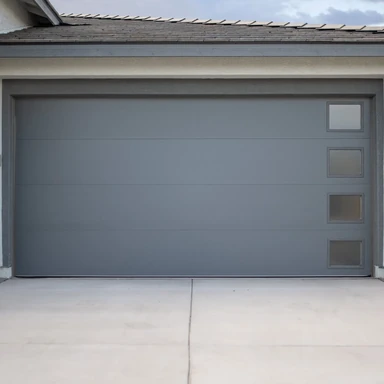
A dented section is a part. Three dented sections and a rusted bottom rail is a decision.
We are a matching service, not the contractor. Panel work goes to licensed garage door companies serving Fairfax County, and you hold the contract and the warranty with the firm you pick. A sectional door is four to six horizontal panels joined by hinges, so one damaged panel is a part number rather than a whole door, as long as the profile can still be matched.
The bottom section takes most of the damage, for three reasons. It is the section a car bumper reaches. It is the section that sits in slush, salt brine and meltwater all winter. And it is the section that carries the bottom seal and the bottom brackets, so it is the first place steel rusts through.
The second most common is a top section bent by a car with a roof rack, or a door that came off track and folded a panel against the header. A middle section usually survives unless something hit it directly.
Panel work is also cheaper than it sounds because the section is the part, not the door. The labor is in releasing the springs, matching the section and rebalancing, and none of that changes because the panel is a foot wider.
This is where panel work gets difficult, and it has nothing to do with labor. Panels are matched on profile, embossment, color, section thickness, hinge position and window insert. Manufacturers retire colors and change panel profiles, and a door installed in 1998 may have no current equivalent.
The door's specification is stamped on a label or an end stile, which is the first thing a technician looks for. If the profile is gone, the options are a close match in a current line, a repaint of the whole door in a single color to hide the difference, or a new door.
Published prices for a panel run $150 to $500 on Fixr, and up to $1,000 for wood, where the section has to be finished to match. That is against $1,200 for a complete door on Home Depot's published line, which is the number that frames the decision on an old door with more than one bad panel.
A technician should carry the label number and a photograph of the profile to the supplier rather than describe it over the phone. A door with a window insert is harder still, because the insert and its frame have to match the new section.
A section cannot be changed with the springs under tension. The technician releases the spring tension, unbolts the hinges between the affected sections, slides the old section out of the track, sets the new one, and transfers the hinges, the strut and the bottom seal. Then the springs are wound back to the correct tension and the door is balanced.
That sequence is why a panel job takes a couple of hours and why it is not a two person job for a homeowner. It is also why a technician should check the balance and the safety reverse afterwards, since the door's weight has changed.
Panels stop being the answer when the door has structural damage rather than cosmetic damage. A bent track that has been bent twice, hinges pulled out of a stile, a door that has been hit in the same corner by the same driver, and rust in more than one section all point the same way.
There is also the arithmetic. Two panels, new hardware and a fresh seal on a twenty five year old door is often most of the way to a new door, and the new door comes with a warranty on the sections. Ask for both numbers in writing and compare them on the same page.
Ask one more question before ordering a panel on a door past twenty years: how long will the next section last? Steel that has rusted in one place has usually started in two others.
Yes, if the new section matches the profile and the rest of the door is sound. The bottom section is the one most often replaced, because it takes the salt, the slush and the bumper hits.
Not always. Colors and profiles are discontinued, and a panel that is close but not identical shows in daylight. A technician should check the door label and confirm the match in writing before the section is ordered.
Not safely. The springs have to be released and re-tensioned around the work, and a residential torsion spring holds enough energy to cause serious injury. Panel replacement is a technician job with a balance check at the end.